
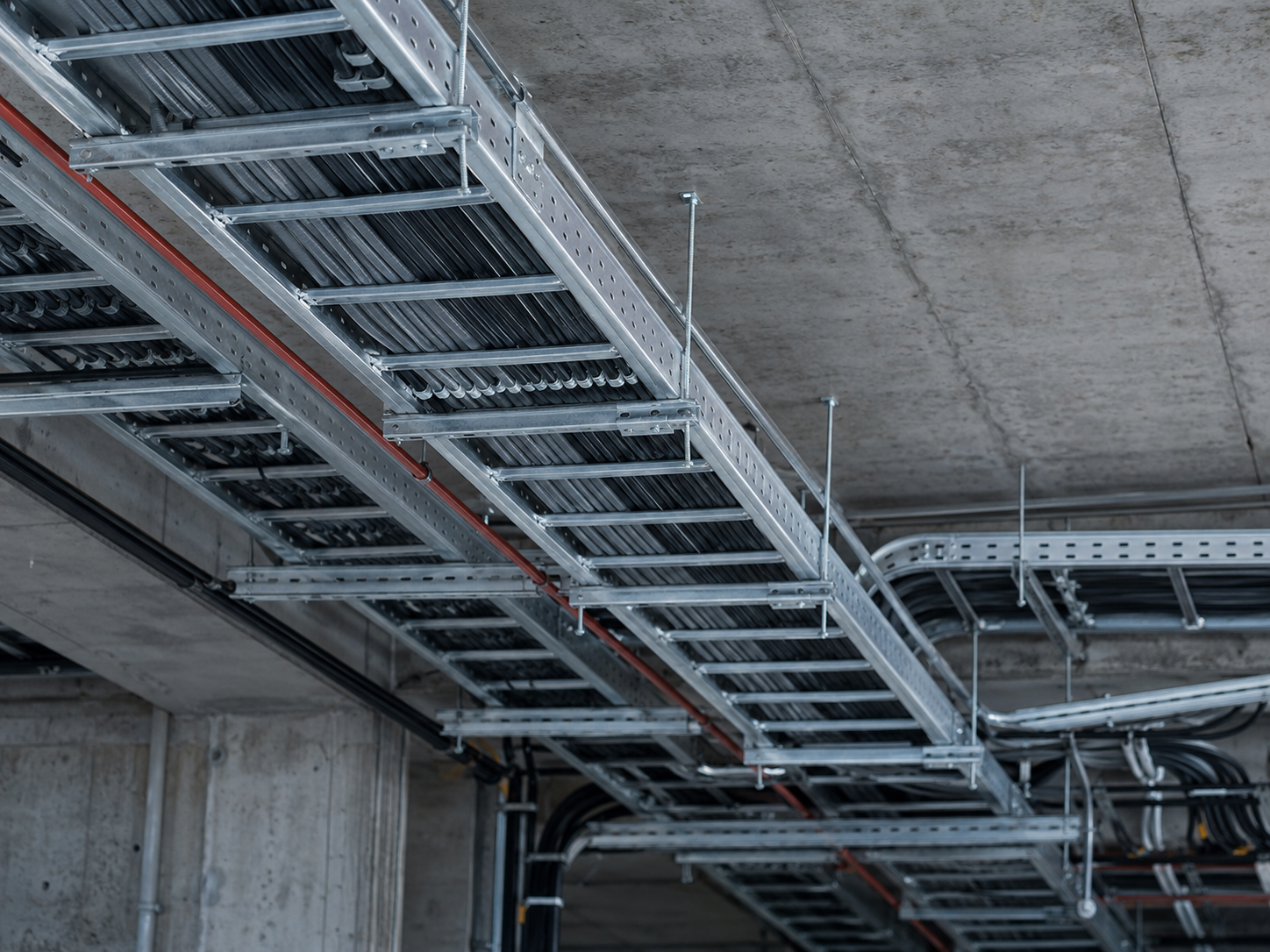
Cable Ladders
BMT cable ladders give rung-style support for heavier cable runs where ventilation and ease of access matter most — the natural choice for main distribution routes and high cable-fill installations. Complete ladder systems are available with matching bends, tees, risers, and crosses, in painted, pre-galvanized, hot-dip galvanized, stainless steel, aluminium, or FRP finishes.
Specifications
| BMT Product Line Code | BMT-CL-[thickness] |
|---|---|
| Standards Referenced | IEC 61537:2007 · BS EN 61537:2007 · NEMA VE 1-2009 · NEMA VE 2-2006 · NEC (ANSI/NFPA 70) |
| Materials & Finishes | Aluminium 6063 T6 (swaged tubular rung) and Steel S235 JRG2 (welded C-channel / swaged tubular rung), in painted, galvanized, stainless, or FRP finishes. |
| BMT-CL-A — Swaged Tubular (Aluminium), 25 mm dia. | 229 mm standard rung spacing · NEMA Class A / 8A / C / 12A / 12B |
| BMT-CL-S — Swaged Tubular (Steel) | 229 mm standard rung spacing · NEMA Class 8C / 12A / 12B / 16A / 12C / D |
| BMT-CL-C — Welded C-Channel (Steel), plain or slotted | 229 mm standard rung spacing · NEMA Class 8C / 12A / 12B / 16A / 12C / D |
| Components & Accessories | 90° welded curves · straight connectors · welded curved inside risers · welded curved equal tees · welded cornered crosses |
Frequently Asked Questions
When should I use a cable ladder instead of a cable tray?
Cable ladders suit heavier cable loads and long straight runs where ventilation and easy cable access are priorities, such as main distribution routes.
Do you supply GRP cable ladders?
Yes, GRP cable ladders are available for corrosive, chemical-exposure, or non-conductive installation requirements.
What rung spacing is available?
Our cable ladders use a standard 229 mm rung spacing across the aluminium and steel rung types.